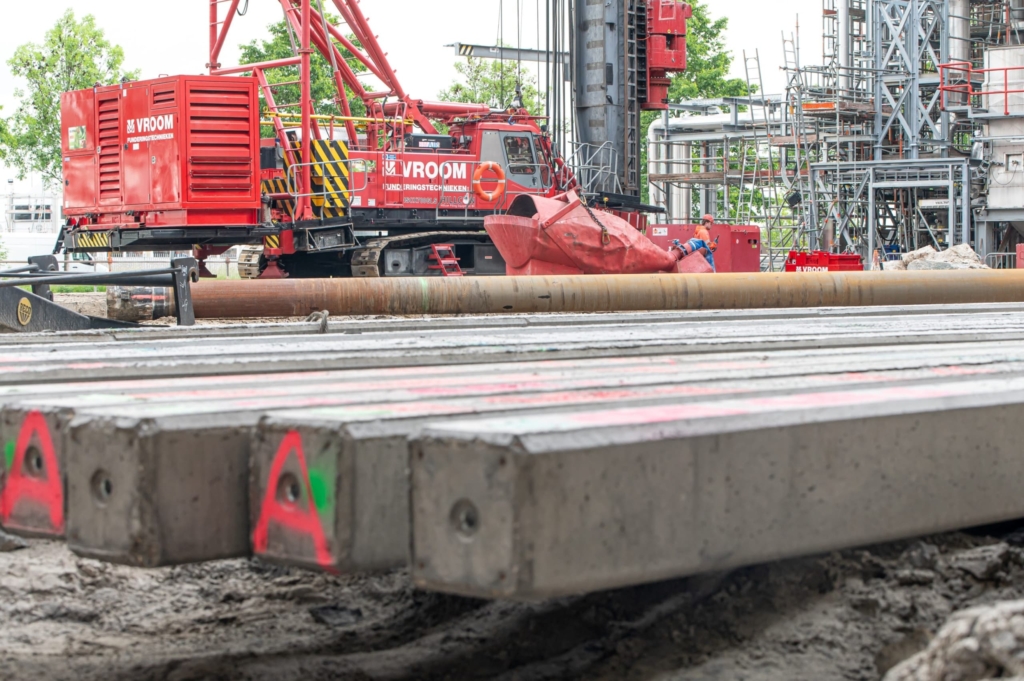
This year, Vroom will have been in existence for 60 years. We will reveal our rich history here regularly, using images from back then illustrated with, not least, facts, figures and anecdotes from our past.
Pile driving using wooden and pre-cast concrete piles long remained Vroom’s most important line of business. And that did not change when the three brothers established a holding company, Gebr. Vroom Holding B.V., in 1978.
From 1978 onwards the holding company became an umbrella for the operating companies Handelmaatschappij Vroom and Materieelbeheer Vroom and HBF (the Hydro, Drilling and Foundations Technology unit), each with its own specialisation and prospects. All ancillary activities came to an end. At the start of the 1980s, Vroom was confronted with a sharp fall in turnover for the first time in its history and, as a result, went through some rough times. The first two Hitachi KH125 machines were acquired in that period. We saw the start of development of the first compressed-air driven piling rigs. Vroom did everything possible to motivate its employees and outlined the following vision of the future in its Christmas wishes: “If we all try to go the extra mile, none of us will have to make sacrifices; you have that character, so make use of it. Always stay ahead of the competition.”
Specialisation takes shape
Vroom worked on its first projects with vibrated-pile foundations in the early ’80s in Tiel and Arnhem. And the good contact since the 1970s between Vroom and fellow foundation business Piet van ‘t Wout became more serious when Klaas Vroom and Piet van ‘t Wout began working jointly on hydro, drilling and foundation technology. Both piling contractors knew that HBF could signal a turning point in terms of ‘traditional’ thought in the world of construction if the new technologies were of a high enough standard. And, in 1981, the Hitachi KH125 was used for the first drilling work carried out by Vroom.
The second-hand equipment which these men were using at the time to make piles was not equipped with all of today’s technical mod cons. There was no air-conditioning, so they had to wind down the window. Back then it was as if the wheel had to be reinvented, using all the available technology.
Berry Oortwijn: “In the early days of vibrated-pile foundations we worked with driving helmets, and steel straps that were first wrapped around the tube without snap anchors. Then it was a case of pulling for all you were worth. That meant a lot of wear and tear. As machine operators we had to do or think up whatever it took so that we could keep producing the piles, with the support of equipment management in Middelie.
In the early ’80s, Klaas Vroom asked Berry Oortwijn and Gerrit Roelofs to swap from pre-cast concrete piles to cast in-situ vibro piles. These piles had already been in production in the Netherlands for some time, albeit made under licence. Once that licence expired, Klaas Vroom seized the opportunity to take on work with this pile system. Berry made the move to vibro piles immediately, but Gerrit initially decided to bide his time. He was waiting until the first GLS machine arrived. That explains why Johan Veerman, too, switched to vibro piles before Gerrit Roelofs.
Berry began with the Hitachi KH180-1, producing vibro piles for 12 consecutive years. Ultimately, the first vibro-pile piling rig was lifted onto the haulier’s transport, destination Tiel, on 21 June 1982. The assembly and the preparations for the first work using the rig lasted until the end of June. Berry: “The first vibrated pile was sunk into the ground on 1 July 1982. At that time, things had to be done with whatever equipment was available, or could still be used or patched up. Vibrated-pile foundations immediately proved ideal for residential construction. High-rise office blocks were more problematic: they needed longer, larger-diameter piles. That led to scenes like the time in the Bijlmer in Amsterdam, when we were happily hammering away until, once the concrete was poured in, we discovered that the casing, which we thought we’d never get in, was now impossible to get out.”
These things started to get a bit easier from the point at which the IHC hydraulic hammers came on the scene.
Dirk Beets: “In the early days, teamwork was an important part of boring and drilling. Everything was done with the scoop, and there was no auger cleaner. Lifts, light excavators? Forget it. At the end of each day you were a sight for sore eyes.”